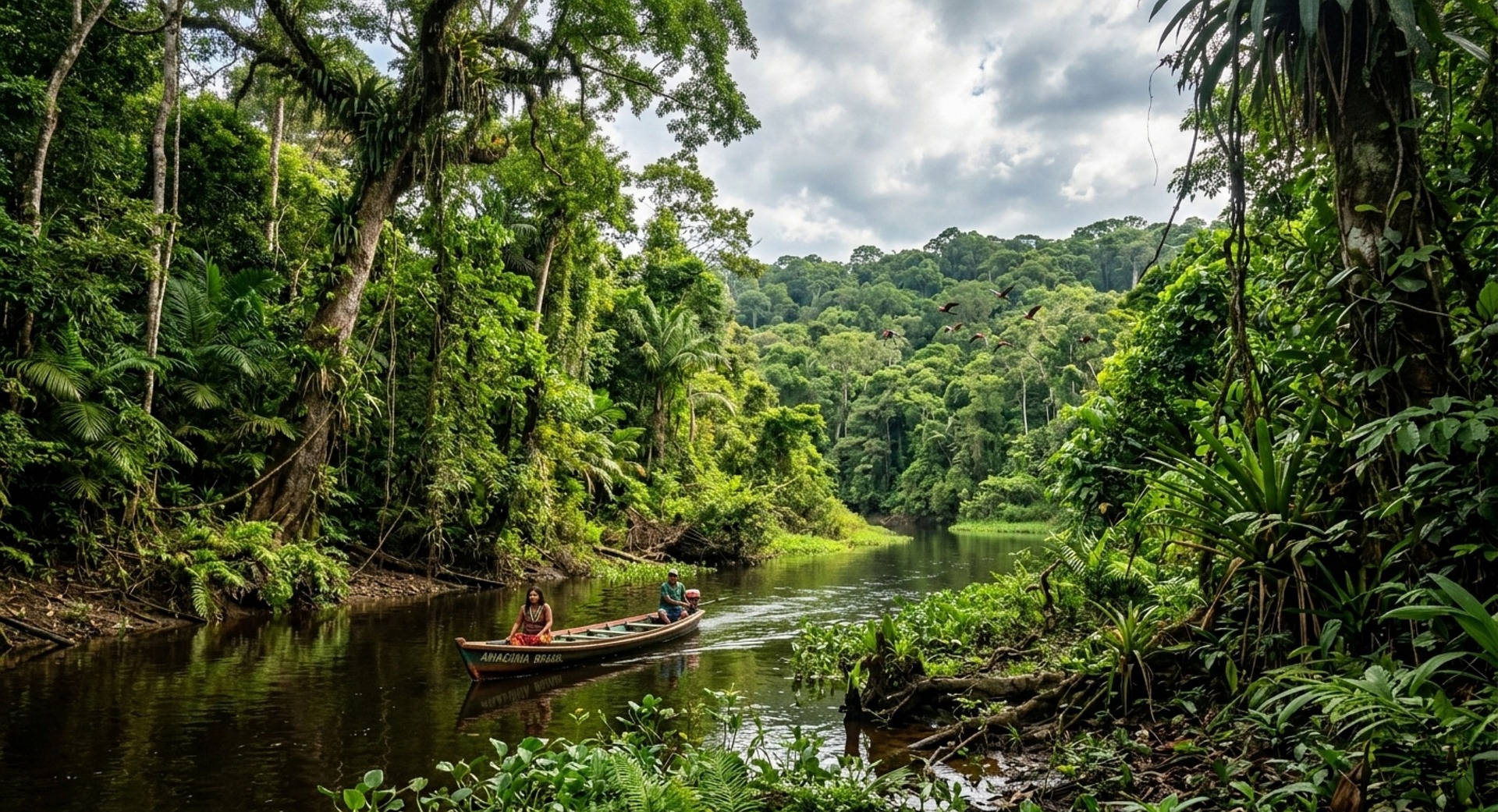
When you hear the word “utopia”, what do you picture? Is it a lush pre-industrial paradise, abundant in natural wildlife? Or perhaps a high-efficiency metropolis defined by social democracy and flying cars? For others it’s a solarpunk dream with a hybrid of permaculture, smart technology, and community-centric living.
Whichever way we define it, utopia feels far removed from our current reality. For some communities around the world however, the fantasy is a reality. “Utopias exist, but they are systematically ignored and marginalised,” says Marisol Manfredi, economist, doctoral researcher and PhD candidate at Istituto Universitario di Studi Superior.
At the ChangeNOW 2026 climate conference, ignored communities that live in this reality took centre stage. In a provocative panel, speakers including Manfredi challenged the capitalist systems most of us have accepted as the norm, exploring radical alternatives.
But first, let’s look at what utopia actually means.

Abundance, infrastructure or equality?
Ancient Greek and Roman poets like Hesiod and Ovid famously theorised the ages of humanity. It all began with a Golden Age where the Earth provided an abundance of food freely, and humans lived in peace and harmony with nature. This concept of a lost paradise persisted for centuries, mirrored in the Garden of Eden across Abrahamic faiths, until the Industrial Revolution shifted the human psyche.

depicting a romanticised vision of paradise in ancient Greek mythology
Scientific optimism replaced the lush landscape with a desire for the perfect system. Perfection was found in high-speed travel, sanitary concrete, and total human control over the environment. Infrastructure became the new salvation.
Writers like Edward Bellamy, in his 1888 novel Looking Backward, portrayed a socialist state, where technology solved all suffering, a concept echoing the rigid, organised society of Thomas More’s Utopia (1516). With economic equality for all, he focused on collective, rather than individual, profit, which includes military-like labour.
Today, many people have more of a solarpunk vision of what utopia is. It’s concepts like NEOM’s attempt in Saudi Arabia; high-tech, regenerative infrastructure embedded within lush landscapes. The aim is to encapsulate the natural world paired with the safety and advancement of modern standards.
But while the Global North continuously redefines its idea of utopia, Indigenous communities have been living in it for thousands of years.

You cannot eat money
At ChangeNOW 2026, Manfredi gives an example of 33 indigenous communities in Jujuy, Argentina that live by the principles of Buen Vivir. This eco-centric philosophy prioritises harmony with nature, community, and holistic well-being over capitalist development and material growth.
These communities have thrived for millennia, yet their way of life is now threatened by a singular force: Western extraction. With colonial roots, extractivism is still a major issue today. Under the guise of a green transition, their lands are being mined for lithium – the key ingredient in the batteries that power our smartphones, laptops, and electric vehicles.

As Timothée Parrique, researcher in Ecological Economics, University of Lausanne puts it, “we’re treating nature as an all-you-can-eat buffet.” The global economy rewards extraction and short-term profit, while undervaluing the work that sustains life.
“Money is still being invested in companies that are threatening the survival of our communities and the planet. Is it OK that the world is dying and people still want to make profit from it?” asks Xananine Calvillo Ramirez, Founder of Jna Tsjo Collective with Ngiwa and Tutunaku roots from Pueblo, Mexico.
The disparity is staggering: Parrique notes that the richest 20% of the global population is responsible for 72% of all metal use, 63% of carbon emissions, and 55% of biodiversity loss.
The myth of green capitalism
There is a growing mismatch between what capitalism delivers and what humanity actually needs. While the Global North is marketed superficial solutions to manufactured needs, many people around the world face skyrocketing economic instability, food insecurity, environmental degradation, and displacement. The promises and pledges of corporate CSR are often hollow. As Parrique points out, “green capitalism is a story we tell to avoid changing the system.”

Nemonte Nenquimo, leader of the Waorani Nation and co-founder of Amazon Frontlines reminds the conference that while the West talks about aiming for change, Indigenous people have held the solutions for millennia. “Humans are waging war across the world based on extraction,” she shares, “and behind all these wars is the blood of our [Indigenous] ancestors.”
She expresses how the system has grown addicted to fossil fuels and dependent on an imperialist structure that treats the planet as a commodity rather than a home.
The bridge between worlds
Chief Tapi Yawalapiti, chair of Instituto Aritana and honorary President of Rainforest Organisation, feels a profound urgency to share his community’s knowledge, specifically the deep interconnectivity of the forest that the Western world has largely forgotten.

His perspective is unique: his father taught him to master both the Indigenous and the Western systems, emphasising that the survival of humanity depends on their convergence. As a graduate in social and environmental sciences from the University of Brasília, Yawalapiti embodies a new generation of Xingu warriors. Rather than retreating from the modern Western world, they are engaging with it to save it.
By partnering with international governments and helping establish Brazil’s first Indigenous Affairs Ministry in 2023, Yawalapiti is proving that ancestral culture can, and must, inform modern policy. “I keep fighting so we can preserve not only the forest, but our way of life,” he says.

The lesson from these powerful speakers at ChangeNOW 2026 is clear. We cannot build a utopia through extraction, nor can we simply wish our way back to a primitive past. Instead, we must forge a new way where Western innovation is guided by Indigenous stewardship.
As Nenquimo poignantly reminds the audience, the Earth does not need us to save it; the Earth will thrive with or without humans. The quest for utopia, therefore, isn’t about saving the planet. It’s about saving our place within it.
If utopia is the perfect place, perhaps it isn’t a futuristic city or a lost garden. Perhaps it is simply the moment we stop treating the world as a buffet and start treating it as a home.
Support independent, honest journalism
At STERNA, we believe travel journalism should provoke new thought, inspire positive change, and highlight the purpose-led and sustainable businesses protecting our planet and local communities.
True, independent storytelling takes intention and deep research. We operate without clickbait, sensationalism, or corporate bias.
By contributing to STERNA, you directly fund independent journalism and help us bring more stories of positive environmental and cultural impact to light.
If our work has inspired you, consider supporting our mission.
Contribute to support independent journalism.
At STERNA, we believe travel journalism should provoke new thought, inspire positive change, and highlight the purpose-led and sustainable businesses protecting our planet and local communities.
True, independent storytelling takes intention and deep research. We operate without clickbait, sensationalism, or corporate bias.
By contributing to STERNA, you directly fund independent journalism and help us bring more stories of positive environmental and cultural impact to light.
If our work has inspired you, consider supporting our mission.
Contribute to support independent journalism.
Choose an amount:
Or enter a custom amount:
Your contribution is appreciated, and helps to keep our site ad-free.
Your support is appreciated, and helps to keep our site ad-free.