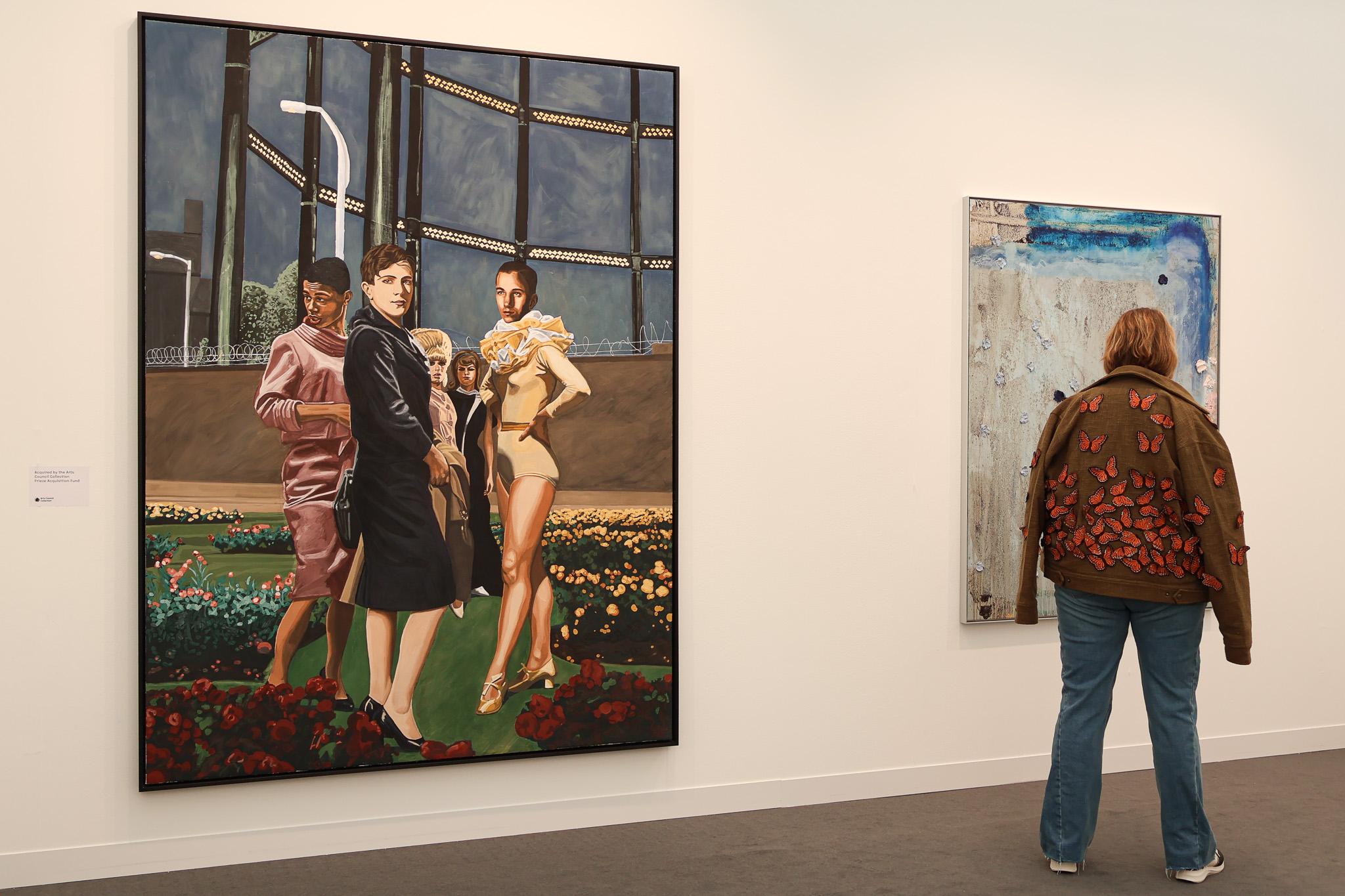
There are three types of people that attend Frieze London. Art enthusiasts who are there to immerse themselves in the work. People in the art industry who use it as a chance to reconnect with international friends and peers. And finally, the artistically alternative fashionista serving as living art pieces, Instagram-ready to document their attendance.
Yet whatever brings visitors through the doors, there’s no denying the fair’s singular ability to draw an eclectic global community. Frieze London and Frieze Masters saw record attendance from global celebrities, international collectors and patrons, and museum groups.
Building on last year’s milestone, the 2026 edition reinforces its standing as an international cultural crossroads. This year, the combined fairs welcomed 95,000 visitors from 108 countries and regions, including a record number of representatives from 426 institutions across 51 countries and regions.

A celebration of cultural expression
Rich in international diversity, Frieze London explores how contemporary art is a conduit for local heritage and global discourse. The curated Focus section in particular serves as an engine for global discovery, dedicating space to 35 young galleries that highlight how local cultural narratives shape contemporary practice.
Emerging perspectives from across the Americas take centre stage through galleries like Toronto’s Franz Kaka, which champions cutting-edge North American contemporary art, and Los Angeles’s Ehrlich Steinberg, presenting immersive, concept-driven installations.
The section also offers a window into rapidly evolving non-Western art hubs. In East Asia, Seoul’s G Gallery elevates emerging regional contemporary voices, while Shanghai’s Linseed showcases next-generation Chinese conceptual artists. Meanwhile, Cairo-based Gypsum provides an essential platform for experimental Middle Eastern contemporary art.

By bringing these regional spaces into direct conversation with globally renowned galleries, Frieze London 2026 reinforces that contemporary art’s true vitality lies in its ability to bridge geographic boundaries, preserve cultural identity, and foster meaningful global exchange.
Global powerhouses, emerging regional voices and reframing histories
The breadth of international representation across Frieze London 2026 spans established global giants to hyper-local experimental spaces. Major international galleries anchor the main section, with the likes of Gagosian, Hauser & Wirth, David Zwirner and Pace Gallery presenting works by internationally renowned practitioners whose careers span continents. These multi-location galleries provide a canvas for established voices.

Meanwhile at Frieze Masters, the Spotlight section expands to its largest edition to date under new curators Dr Devika Singh and Dr Sofia Gotti of London’s Courtauld Institute of Art. Dedicated to pioneering mid-century work produced between the 1950s and late 1970s, the section shines a light on vital artistic movements across South Asia, South America, Europe, North and West Africa, and East Asia. By revisiting these overlooked mid-century archives, Spotlight reframes modern art history beyond its traditional Western canonical borders.
Award winning artists from across the globe
Degussa Young Generation Art Award Winner 2026
Winner of the Degussa Young Generation Art Award 2026, multidisciplinary Nigerian artist Ken Nwadiogbu presents a body of work specifically for Frieze London 2026. Entitled I Know the Shadows Will Always Be There, these works reflect a deep desire to reconnect with his heritage. “Everywhere I go, I carry the energy of my culture and my ancestors, regardless of whether or not it is visible to anyone else in the room,” says Nwadiogbu.
In these new works, he uses fibres of Akwete fabric, a prestigious, handwoven textile produced by Igbo women in the town of Akwete in Abia State, Nigeria. Traditionally, the fabric signifies wealth, status, cultural heritage, and personal identity.
Born in Lagos in 1994, he originally trained in civil engineering before earning a degree at the Royal College of Art. Nwadiogbu explores the psychological weight of diaspora and migration in his work. “I’m always thinking about how I can bring my community into my work, and use my community to tell stories about the resilience of many immigrants like me,” he explains.

2026 Frieze Stand Prize
The late, self-taught Indonesian artist Oototol (1956–2021) speaks to art-historical recovery and a subversive critique of postcolonial state identity. Rooted in the artistic lineage of Bali, he fuses the flat visual language of Kamasan wayang puppet theatre and ancient temple reliefs with Chinese ink on canvas, crafting a satirical commentary on modern Indonesian political history.
Presented as part of the curated section The Code Universe, his works rewrite the propaganda iconography of Sukarno, Indonesia’s first president. By endlessly multiplying Sukarno’s hyper-masculine military persona into an army of soft-edged, dazed, and androgynous clones balancing on penny-farthings, motorcycles, and toy aeroplanes, Oototol transforms authoritarian state power into an absurd, circus-like theatre.
This cross-cultural storytelling ultimately won the prestigious 2026 Frieze Stand Prize for the transnational gallery collective Valentine (a collaboration between ROH, Misako & Rosen, and LC Queisser). The jury praised the booth for its historical work and oblique social commentary that feels urgently relevant today.